culture
Itadakimasu: What Japanese People Say Before Eating
Learn what itadakimasu means, who or what it thanks, how it differs from bon appétit and grace, and when to say it before a Japanese meal.
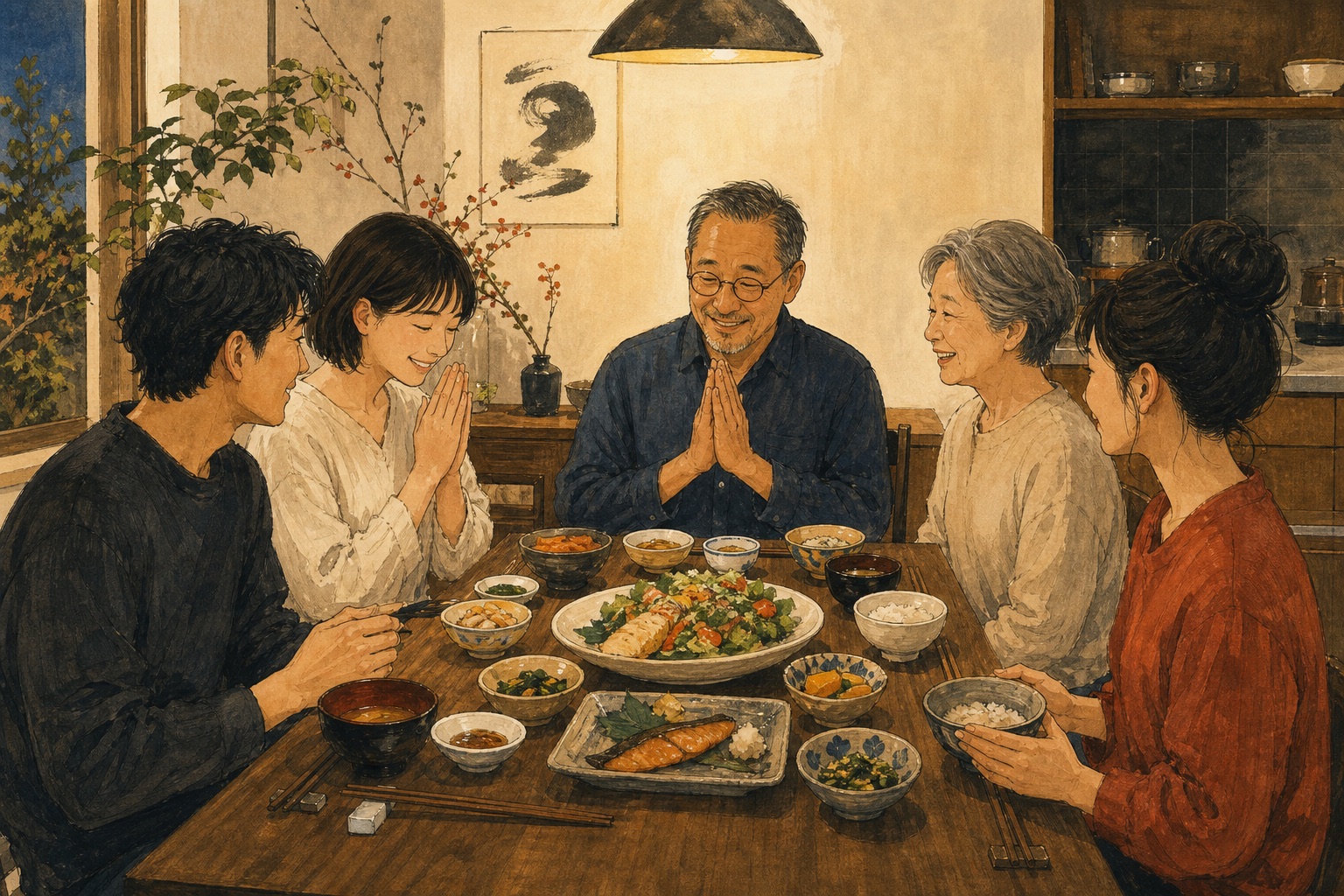
A meal is on the table. Before anyone begins, people briefly pause. Some bring their hands together; others simply lower their gaze or hold still. Then they say:
いただきます。 Itadakimasu.
English introductions to Japanese often translate this as “let’s eat,” “bon appétit,” or even “thank you for the food.” Each points toward part of the scene, but none matches the grammar and social direction of the Japanese expression.
Itadakimasu is built around receiving. It is said by the person about to eat, acknowledging that the meal has reached them through ingredients, living things, nature, and human work.
The short answer
Itadakimasu is a customary expression said immediately before eating. Its basic verbal meaning is “I humbly receive,” while its cultural function is to mark the beginning of the meal and express appreciation for what made the food possible.
In natural English, the same moment might be handled with:
- “Let’s eat.”
- “Thanks for the food.”
- “This looks wonderful.”
- “Bon appétit.”
- a prayer or blessing in a religious household
- or no set phrase at all.
These are situational comparisons, not literal equivalents.
What the verb means
いただきます — itadakimasu is the polite non-past form of いただく — itadaku.
In ordinary grammar, itadaku is a humble verb used for receiving something and, in appropriate contexts, for eating or drinking. Humble language lowers the speaker’s own action relative to the person from whom something is received.
The Ministry of Agriculture, Forestry and Fisheries explains that itadaku originally referred to placing something on the head and later developed the meanings “to receive” or “to partake.” Objects granted by someone of higher status were traditionally raised respectfully toward the head.
At the table, no object has to be spoken aloud. The food before the speaker is understood:
(この食事を)いただきます。 (Kono shokuji o) itadakimasu. “I humbly receive (this meal).”
That grammatical direction matters. The diner is not primarily telling everyone else to start. The diner is announcing their own receiving.
Who is being thanked?
There is no single person named in the phrase. Official Japanese explanations describe several overlapping objects of gratitude.
The Ministry of Agriculture, Forestry and Fisheries connects itadakimasu with thanks for nature, farmers and other food producers, people who prepared the meal, and the processes that brought food to the table. A Government of Japan publication also describes indebtedness to nature and Earth, producers, ingredients, and the lives of animals that nourish people.
This wider explanation is useful, but it should not become a test of what every individual consciously thinks each time. A familiar expression can carry cultural associations even when a speaker says it quickly out of habit. One person may actively feel gratitude toward the cook; another may think about the ingredients; a child may simply know that it is what the family says before beginning.
It is more accurate to say that the phrase makes room for gratitude than to claim that every use contains an identical spiritual belief.
Is it a prayer?
Not inherently.
Itadakimasu has no named deity, no request for divine blessing, and no fixed religious text. It can be used by people regardless of religious belief. Calling it “Japanese grace” helps some English speakers locate the moment—just before eating—but it can incorrectly imply that the expression is a prayer.
The gesture sometimes accompanying it can add to the confusion. Some diners place their palms together, a gesture called 合掌 — gasshō. The same hand position appears in Buddhist practice, but at meals it does not automatically turn the expression into a religious ceremony. Practices also differ among households and individuals: not everyone makes the gesture, and the depth or formality of the pause varies.
The safest description is a pre-meal expression of receiving and appreciation, not a universal Japanese prayer.
Why “bon appétit” is not the same
French bon appétit and English “enjoy your meal” are wishes directed toward other diners. A host, server, or companion can say them to someone who is about to eat.
Itadakimasu is normally said by the people who will consume the meal. A cook may join in if they are also eating, but a restaurant server does not usually present a plate and say itadakimasu to the customer. The server might instead say:
ごゆっくりどうぞ。 Goyukkuri dōzo. “Please take your time and enjoy.”
So “bon appétit” can subtitle the moment effectively, but it reverses who is speaking to whom.
Why “let’s eat” is only partly right
When one person says いただきます and the group begins, “let’s eat” creates the correct action in English. It is especially natural in subtitles, where timing matters more than verbal structure.
But English “let’s eat” is an invitation or suggestion. Japanese itadakimasu is not grammatically a command or invitation. Someone eating alone can say it, and each diner may be understood as saying it for themselves.
Use “let’s eat” as a functional translation when a group is starting. Do not use it as the dictionary meaning of the verb.
When should you say it?
At a meal in someone’s home
Wait until the food is served and the group is ready. Saying いただきます with the others is natural and appreciative. A slight nod is enough; copying an elaborate gesture is unnecessary.
At a restaurant
People commonly say it quietly to their companions before beginning. It is not normally an announcement to the entire room, and you do not need to call the server back in order to say it to them.
When someone gives you food
If you receive a snack or gift to eat later, ありがとうございます — arigatō gozaimasu directly thanks the giver. Itadakimasu may be said when you actually begin eating or, in some contexts, as you accept something you are about to consume. The two expressions do different work and can both appear.
When eating alone
Some people say itadakimasu alone; others do not. Because the expression marks receiving rather than merely coordinating a group, being alone does not make it incorrect.
In casual speech
The standard form is already brief. Playful or compressed pronunciations occur, but learners lose nothing by using a clear いただきます.
What comes after the meal?
The conventional closing is:
ごちそうさまでした。 Gochisōsama deshita. “Thank you for the meal.”
ごちそう — gochisō now means a feast or special meal, but its written form ご馳走 contains characters associated with running about. The common explanation connects this to the effort once required to gather and prepare food for a guest. Gochisōsama deshita recognizes the meal and the work behind it after eating.
The pair creates a useful frame:
| Moment | Expression | Direction |
|---|---|---|
| Before eating | いただきます (itadakimasu) | I receive this meal |
| After eating | ごちそうさまでした (gochisōsama deshita) | I acknowledge the meal and the effort behind it |
In a restaurant, diners may say gochisōsama deshita to staff when leaving. That direct acknowledgment of the completed meal often has a clearer addressee than the pre-meal itadakimasu.
A note on universals
Phrases such as “Japanese people always say it” are too strong. It is a widely taught and recognizable custom, but real behavior depends on household, age, setting, company, and individual habit. Some groups say it in unison; some people murmur it; others begin without it.
Similarly, claims that the phrase proves one uniquely Japanese attitude toward nature go beyond what everyday usage can establish. Gratitude for food, labor, hospitality, or life exists in many cultures. What is distinctive here is the conventional Japanese wording and the way it organizes the start of a meal.
Careful cultural explanation should describe the practice without turning every routine use into a national philosophy.
The translation trap
If you memorize itadakimasu as “bon appétit,” you may say it as a host to guests while not eating. If you memorize it as “let’s eat,” you may miss the humble idea of receiving. If you call it a prayer, you may assign a religious intention the speaker did not have.
A better mental model is:
I acknowledge and receive this meal.
That sentence is deliberately broad. The appreciation may encompass the cook, producers, ingredients, living things, nature, and the fact that food is available—without requiring every speaker to hold the same interpretation.
A practical rule for learners
Say いただきます just before you begin eating, especially when sharing a meal with Japanese speakers who use it. A natural voice and small nod are sufficient.
Do not direct it at a customer as though it means “enjoy your meal.” Thank a person who gives you food with ありがとうございます, and use ごちそうさまでした after the meal to acknowledge what you ate and the effort behind it.
Above all, treat itadakimasu as an act of receiving, not a password you must perform perfectly.
For other expressions whose social function is larger than their standard translation, read why otsukaresama means more than “good job” and why yoroshiku onegaishimasu means more than “nice to meet you”.
Source note
The explanations of receiving, food-related gratitude, and gochisōsama draw on the Ministry of Agriculture, Forestry and Fisheries’ English food-education guide, its Japanese article on the meanings of itadakimasu and gochisōsama, and Web Japan’s introduction to the Japanese dining table. These official sources emphasize overlapping aspects of gratitude; this article distinguishes those cultural explanations from claims about every speaker’s private intention.